

Take a look at these shapes. What do you notice? What do you wonder?
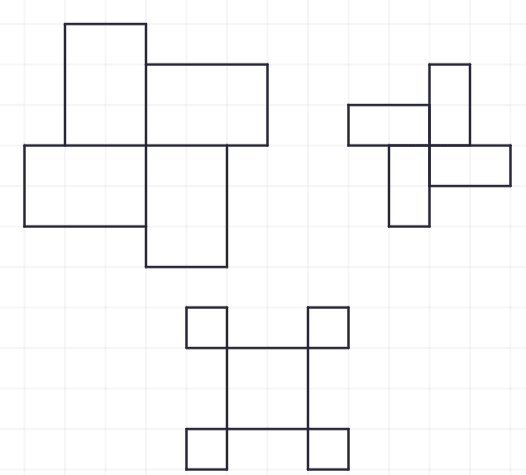
Maybe you've noticed the squares and rectangles. That the shapes look like windmills. Or floor tiles.
Maybe you've seen spirals. And that there's a pleasing symmetry to them.
My favourite thing about maths is how it can constantly surprise us.
Behind those same shapes is a rule that can also produce shapes like this:
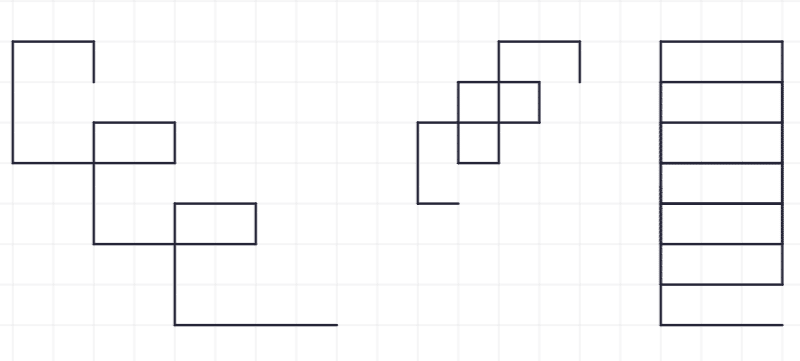
Let me tell you more:
The shapes are all known as Spirolaterals. They were first named in the 1960s by a teenager!
Each Spirolateral is made from a repeated set of numbers, which are then rotated by 90° around a grid. For example, here are the four steps used to make a (1, 2, 3) Spirolateral:

Spirolaterals are an accessible mathematical challenge for 4-year olds and 94-year olds alike!
Investigate Spirolaterals with these questions
Questions to investigate:
- What shapes can you see in your spirolateral?
- Can you make a spirolateral that looks like a square?
- What happens if you make your lines longer or shorter?
Harder questions to investigate:
- Pick any 3 numbers. Which ones meet at a point in the middle? Or make a square?
- Pick any 4 numbers. Which ones spiral up? Down? Ladder?
- What happens if you make a Spirolateral with 5 numbers? 6? 7? 8?
- What changes if you rotate by 60° instead of 90°? Or another angle?
Even harder questions to investigate:
- How might you represent a Spirolateral algebraically?
- What happens if you include negative numbers?
- Pick any 3 numbers. (Or 4, 5, etc.) What is the relationship between the turning angle and whether the spirolateral closes or not?
- Can you program a spirolateral (e.g. using Python)?
Each of these prompts gives learners a starting point. For playing, conjecturing, observing and uncovering surprising connections between different areas of maths.
Want to bring this lesson to life?
Grab our free Spirolaterals lesson kit.
It has solutions, printable grid paper + an online interactive tool for quickly and easily demonstrating any Spirolateral to your students.