

One problem is just the beginning! I'm a big fan of using what you've already got. That is: taking and adapting the resources you already have, and not endlessly searching for new stuff.
With just a few tweaks, your existing resources can become the starting point for so much more. For deeper thinking. For stronger problem solving. And for important mathematical insights, for all learners.
In this article, I share five repeatable strategies you can use for varying a problem.
I’m going to use a problem from the Australian Maths Trust to see each strategy in action, but you can also apply the strategies to problems you already have at hand.
The Cube Nets Challenge
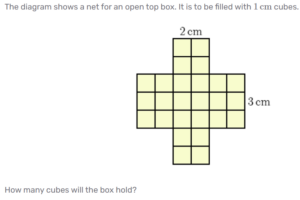
Before I share the five strategies, let’s look at how you might open a lesson involving the Cube Nets Challenge.
Lesson Opener
Start with a physical model of a rectangular prism, e.g. 3 cm x 4 cm x 5 cm.
Ask students:
“What do you notice? What do you wonder?”
These two questions are one of the best diagnostic tools to have up your sleeve! They’ll help you to quickly learn what students know and don’t yet know – and therefore, what support is needed.
Students may notice:
- There are 3 different dimensions: length, breadth and height
- What each dimension is
- The faces are all rectangles
- There are 6 faces
- The area of one face (e.g. 3×4) multiplied by the other dimension (5) gives the volume
- etc.
Starting the lesson in this way, primes students for the main problem that will be posed. It also helps you to know what scaffolds, supports and extensions might be appropriate.
Five Strategies for Varying a Problem
As you read through each of these five tweaks, you’ll notice that they’re all still focused on the same core mathematical ideas as the original task.
However, in each one, students are invited to analyse and make sense of these ideas in different ways.
Strategy 1: Solve in different ways
Solve the original Cube Nets challenge in other ways, e.g. using a physical prism, a net or other numeric methods.
How are your strategies similar? Different?
Why use Strategy 1? Students will verify that their answer is correct. They will also see connections across areas of maths that they otherwise would not have noticed.
Strategy 2: Start with the answer
A box can hold 12 cubes. What might it look like?
Also:
- What other possibilities are there?
- How do you know when you've found them all?
Why use Strategy 2? Students need to think backwards, justify their findings and prove their solution.
Strategy 3: Change the numbers
A box can hold 60 cubes. What might it look like?
Why use Strategy 3? Students need to think more flexibly, generalise their strategies and, in doing so, may start to work more efficiently.
Strategy 4: Change the materials
A 3 cm x 4 cm x 5 cm box is filled with cubes of different sizes (e.g. cubes that are 1cm3, 2cm3, etc.). What’s the least number of cubes required to fill the box (no empty spaces)?
Why use Strategy 4? Students will pull apart the problem features in an entirely new way, helping them to build flexibility and a deeper understanding of the concepts involved.
Strategy 5: Link to a related concept
Out of all the possible boxes that can hold 12 cubes, which one has the largest surface area? The smallest? What do you notice?
Why use Strategy 5? The most powerful skill in maths is to be able to form connections between different skills, concepts and topics. Here students will notice that the closer the dimensions are to a cube, the greater the surface area.
Summary
Five strategies for adapting a problem:
- Solve in different ways
- Start with the answer
- Change the numbers
- Change the materials
- Link to a related concept
Use these to get even more out of your existing resources. And help your students go even further in maths.
—
Have students who give up easily when it comes to problems like these?
Grab our free Questioning Tool.
It has 7 questions designed to guide students through a problem + boost confidence.